
Slotie

NFT Launch for Casino Operator Client

Generated $5.000.000 in NFT sales in five minutes, $10.000.000 in two months.

Funds Raised:$10.000.000+
NFT Sold:15.000 NFTs
Unique Investors:3000+ Investors
Average Order Value:$600 AOV
Case study thumbnail

The Challenge

An experienced online casino operator wanted to raise capital to build one of the first metaverse casinos. The plan: use NFT collections as the primary fundraising vehicle.

The bar was high:

  • Raise 7+ figures in a single day without contract failures or exploits.
  • Handle thousands of concurrent mints without gas wars, failed transactions, or over‑minting.
  • Enforce complex sale logic: presales, public sales, per‑wallet limits, whale tiers, giveaways, and strict supply caps.
  • Protect buyers and the team from security issues around whitelist manipulation, double claiming, and massive ETH balances sitting in contracts.
  • Do it again for a follow‑up collection, with better gas efficiency, more flexibility, and clean integration into a broader “Slotie ecosystem” (staking, breeding, payouts, metaverse integrations).

They needed not just a mint contract, but a full, battle‑tested sale system that could safely move millions in minutes.
Our Plan and Build

We designed and built a two‑collection architecture:

  1. Slotie Originals (10k NFTs) and
  2. Slotie Juniors (follow‑up + breeding).

For Slotie Originals we built:

  • A 2‑phase presale contract:
    • Phase 1: 1 ticket per whitelisted address at 0.08 ETH.
    • Phase 2: up to 3 tickets per address at 0.08 ETH.
    • Separate Merkle roots per phase for tight whitelist control and per‑phase limits.
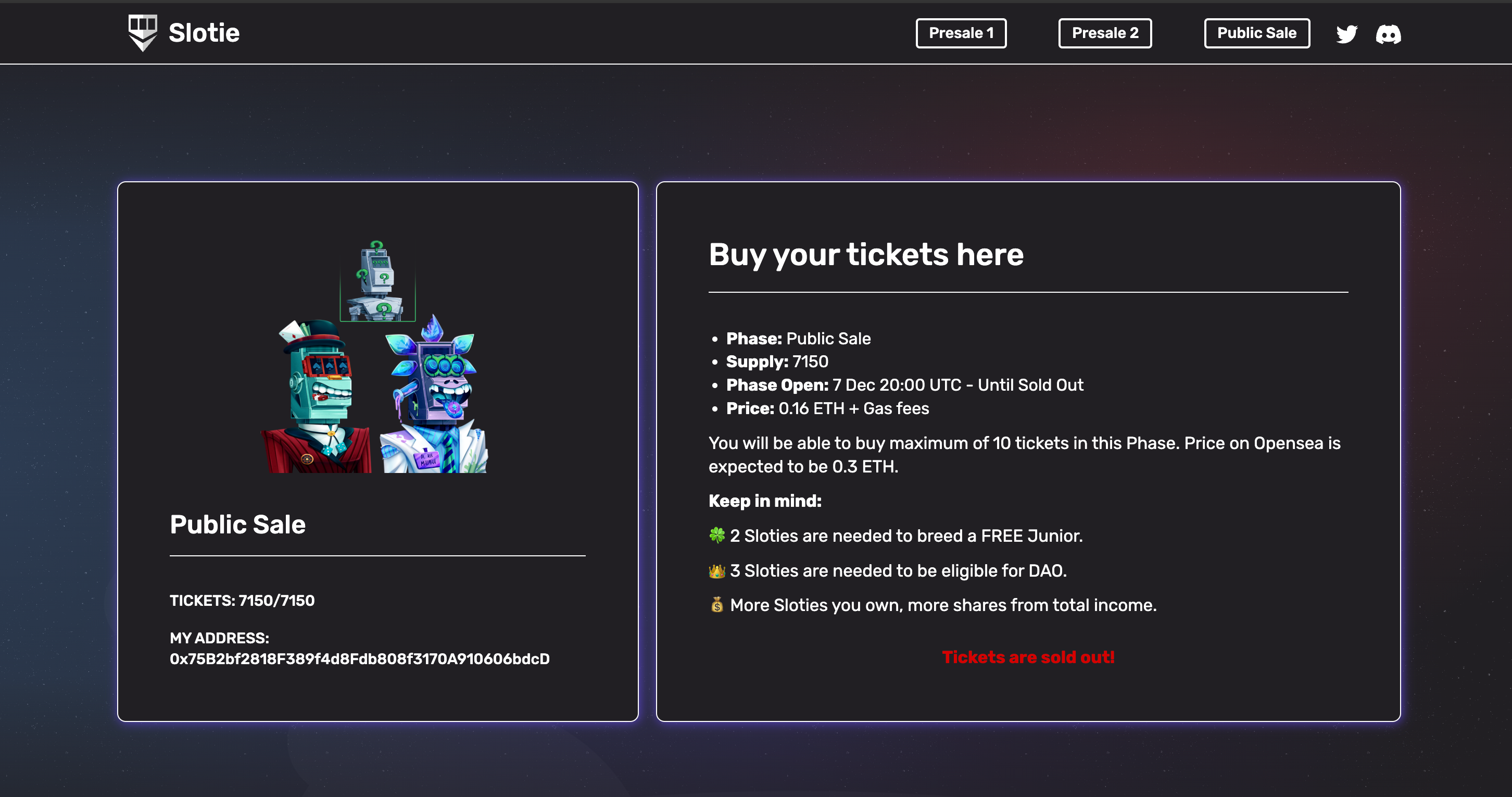
  • A public sale contract:
    • 0.16 ETH per ticket (2x presale price).
    • Tiered access: regular users (max 10), whale pass holders (max 100), with mutual exclusivity to avoid supply domination.
    • Batch minting cap of 30 per tx to prevent gas / DoS issues.
  • A core NFT contract wired for the long‑term:
    • Role‑based access (MINTER, BURNER, DAO), delayed reveal, OpenSea gasless listing integration, WATTS reward hooks, and an immutability lock to freeze metadata after launch.
  • Security patterns:
    • Accumulate‑then‑withdraw ETH flow, .transfer() usage, strict supply checks, exact payment enforcement, anti‑double‑claim mappings, and phase flags to avoid overlaps.

For Slotie Juniors we iterated and upgraded:

  • A 3‑phase ticket sale system:
    • Permissioned Phase 1 & 2 at 0.2 ETH, then an open sale at 0.3 ETH with per‑wallet limits.
    • One Merkle tree encoding address, max amount, and phase eligibility for granular control.
  • A more advanced ticket → NFT redemption pipeline:
    • Separate accounting for permissioned vs open sales, plus isolated giveaway pools.
  • An ERC721A‑based core NFT contract:
    • Gas‑efficient batch minting (up to 500 per tx), transfer hooks for staking/breeding, DAO‑controlled ecosystem contract addresses, metadata freeze, OpenSea proxy integration, and emergency recovery utilities.
  • Hardened security & configurability:
    • Time‑windowed phases, separate supply pools, per‑user caps, transparent events for all config changes, and safe withdrawal patterns.

Key Features

Results and Impact

Slotie Originals (Dec 7, 2021)

  • 1344 ETH raised (~$5.5m at ~$4.1k ETH).
  • 200 ETH (~$820k) via presale; sold out over the full presale period.
  • 1144 ETH (~$4.69m) via public sale; sold out in 5 minutes.
  • ~11.7k total sale transactions, over 90 ETH in gas spent by buyers.
  • Core collection later reached $30.6m+ secondary trading volume and 3.7k holders on Rarible.

Slotie Juniors (Feb 2022)

  • 1380 ETH raised (~$4.47m at ~$3.2k ETH).
  • ~6.5k transactions, ~68 ETH in gas.
  • Cleaner, cheaper, and more flexible implementation building on the first launch.

Overall impact

  • Combined, the systems we built helped the client raise roughly $10m+ across two launches in a few months.
  • Both mints sold out, handled thousands of buyers under extreme time pressure, and operated without critical security failures or supply errors.
  • The modular, role‑based, ERC721A architecture gave the team a solid base for staking, breeding, payouts, metaverse integrations, and long‑term ecosystem growth.

This is the kind of high‑stakes, high‑pressure environment where tight engineering, defensive security, and clear sale logic directly convert into millions raised in minutes.